
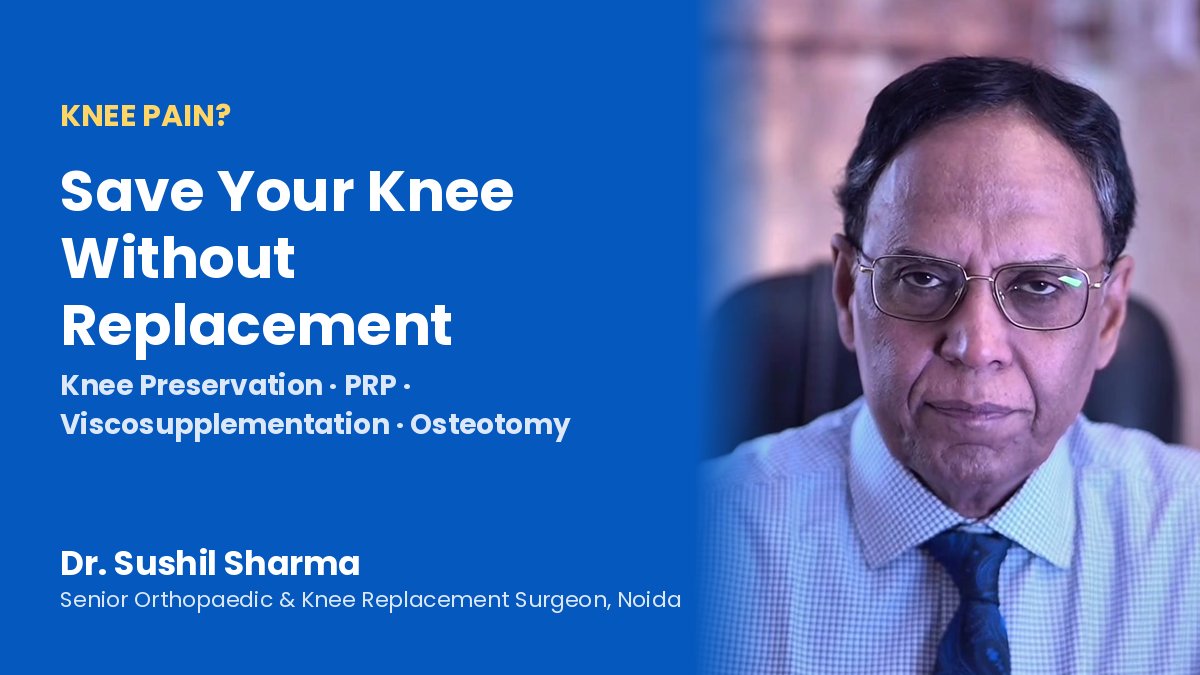
Not every painful knee needs to be replaced. Total knee replacement is meant for end-stage arthritis, usually after the age of 60. For earlier stages, grade 2 and grade 3 arthritis, knee preservation treatments aim to save your own knee instead. These include viscosupplementation, PRP therapy and joint-preserving operations such as high tibial osteotomy.
In this short video, Dr. Sushil Sharma, senior orthopaedic and knee replacement surgeon in Noida with more than 38 years of experience, explains when a knee can be preserved and when replacement becomes the right choice.
Dr. Sushil Sharma on knee preservation (Hindi, 1 min 18 sec). Watch on YouTube. Full transcript further down.
Does your knee pain sound like this?
Knee arthritis rarely starts with severe pain. It creeps into everyday life, and many people put up with it for years:
- The first few steps after getting out of bed or a chair are stiff and painful.
- Climbing stairs at home, or the steps at the metro, has become something you plan around.
- Sitting cross-legged or using an Indian-style toilet is no longer comfortable.
- Your morning walk in the park has become shorter, or stopped altogether.
- Your knee swells or aches in the evening after a long day on your feet.
- You have been told "it's age", or that you will need a knee replacement one day, and you are not sure if that day has come.
If two or more of these sound familiar, your knee is asking for attention. The earlier arthritis is assessed, the more options there are to protect the knee you have.
Not sure what stage your knee is at? A consultation with Dr. Sushil Sharma, including a review of your standing X-ray, tells you the grade of your arthritis and which treatments make sense for you.
What Dr. Sharma says about knee replacement
Most knee pain in adults comes from osteoarthritis, the gradual wear of the cartilage that cushions the joint. Rheumatoid arthritis, an inflammatory disease, can also damage the knee. In the video, Dr. Sharma puts it simply:
"Total knee replacement is done after a certain age, usually after 60, and it is for end-stage arthritis. For people at an earlier stage, grade 2 or grade 3 arthritis, the question is what can be done to save the knee. This is called knee preservation: the knee is not replaced, it is preserved."
Doctors grade knee arthritis from 1 to 4 on a standing X-ray. The grade guides treatment, together with your age, symptoms, activity level and the alignment of your leg. The highlighted rows are where knee preservation is usually considered.
| Grade | What the X-ray shows | Usual approach |
|---|---|---|
| Grade 1 | Very early changes, joint space normal | Exercise, weight control, physiotherapy |
| Grade 2 | Small bone spurs, joint space starting to narrow | Physiotherapy and lifestyle changes; knee preservation treatments if pain persists |
| Grade 3 | Clear narrowing, several bone spurs | Knee preservation: injections or joint-preserving surgery, depending on alignment and age |
| Grade 4 | Severe narrowing, "bone on bone" | Knee replacement, total or partial, usually considered |
Pain does not always match the X-ray. Some people with grade 3 changes manage well, while others with grade 2 struggle, which is why an examination matters as much as the scan.
When replacement is the right choice, read about knee replacement in Noida and partial vs total knee replacement.
Knee preservation: treating knee pain without replacement
Knee preservation means treating the knee you have, to relieve pain and slow further damage, so that replacement is delayed or not needed.
Dr. Sharma uses several approaches, often in combination. No injection or operation reverses arthritis completely, and none suits everyone. The right choice depends on your arthritis grade, which part of the knee is worn, your leg alignment, your age and how active you want to be.
| Treatment | What it is | Who it may suit | What to expect |
|---|---|---|---|
| Exercise, physiotherapy and weight control | Strengthening the thigh and hip muscles; losing excess weight to reduce load on the knee | Everyone with knee arthritis, at every grade | The foundation of all other treatment; improvement builds over 6–12 weeks |
| Viscosupplementation | An injection of hyaluronic acid, a gel that lubricates and cushions the joint | Mild to moderate osteoarthritis | Results vary; patients who respond often get several months of relief |
| PRP therapy | Platelet-rich plasma, prepared from your own blood and injected into the knee | Early to moderate osteoarthritis | Relief can last months; it eases pain but does not regrow worn cartilage |
| High tibial osteotomy (HTO) | An operation that re-aligns the shin bone, shifting weight from the worn inner side of the knee to the healthier outer side | Younger, active patients with bow legs and wear mainly on one side | Hospital stay and a few months of rehabilitation; can delay replacement by years |
Find out if your knee can be saved. Dr. Sharma will review your X-rays, examine your knee and tell you honestly whether preservation or replacement is the better path.
How Dr. Sharma decides the right treatment
Every knee is assessed in the same four steps before any treatment is suggested:
- Your story. Where it hurts, for how long, and what you can no longer do, from stairs to sitting on the floor.
- Examination. Swelling, range of movement, stability and the alignment of your leg.
- Standing X-rays. To grade the arthritis and see which part of the knee is worn; an MRI only when it would change the plan.
- A clear plan. Preservation, replacement, or simply physiotherapy and follow-up, explained so you can decide with your family.
Three situations patients often bring to the clinic
Typical examples, not individual patients.
- Early stiffness in a desk job. A 45-year-old with knee pain after long sitting and on stairs, and grade 2 changes on X-ray. Usually helped by physiotherapy and weight control, with an injection if pain persists.
- An active person with bow legs. A 52-year-old who walks and travels a lot, with grade 3 wear on the inner side of the knee. Often a candidate for high tibial osteotomy, which keeps the natural knee.
- Bone on bone after years of pain. A 68-year-old whose pain disturbs sleep despite medicines, with grade 4 arthritis. Here, knee replacement usually gives the most reliable relief, and preservation treatments add little.
Treatments are offered at Kailash Super Speciality Hospital, Sector 27, Noida; R. K. Orthopedic Hospital, Patparganj; and Dr. Sharma's clinic in Mayur Vihar Phase II, Delhi.
Frequently asked questions
Can knee pain be treated without surgery?
Yes, in many cases. Early and moderate knee arthritis often improves with physiotherapy, weight control, medicines and injections such as PRP or viscosupplementation. Surgery is considered when these no longer control the pain.
What is knee preservation?
Knee preservation means treating your own knee to relieve pain and slow damage, instead of replacing it. It includes injections such as PRP and viscosupplementation, and joint-preserving operations such as high tibial osteotomy.
Who is a good knee pain specialist in Noida?
Look for an orthopaedic surgeon who offers both preservation treatments and knee replacement, so the advice is not limited to one option. Dr. Sushil Sharma is a senior orthopaedic and knee replacement surgeon in Noida with more than 38 years of experience and over 10,000 joint replacements, who also offers PRP, viscosupplementation and osteotomy.
Can grade 3 knee arthritis be treated without replacement?
Often, yes. Many people with grade 3 arthritis manage well with physiotherapy and injections, and some are suited to high tibial osteotomy. The choice depends on your symptoms, age and leg alignment.
Is PRP effective for knee arthritis?
PRP can reduce pain and improve function in early to moderate osteoarthritis, with relief that may last several months. It does not regrow worn cartilage and is less helpful in severe arthritis.
How long does viscosupplementation last?
In patients who respond, relief usually lasts several months, and the injection can be repeated. Results vary from person to person, so it is not suitable for everyone.
What is high tibial osteotomy, and who needs it?
It is an operation that re-aligns the shin bone to move weight away from the worn inner side of the knee. It suits younger, active patients with bow legs and arthritis mainly on one side, and can delay knee replacement by years.
When is knee replacement necessary?
Knee replacement is usually advised for grade 4, end-stage arthritis, typically after the age of 60, when pain limits daily life despite other treatments.
When should I see a doctor for knee pain?
See an orthopaedic doctor if pain lasts more than a few weeks, keeps returning, disturbs sleep, or follows an injury. Seek care urgently if the knee is red, hot and swollen, locks, gives way, or you have a fever.
Where can I get knee pain treatment in Noida?
Dr. Sushil Sharma consults at Kailash Super Speciality Hospital, Sector 27, Noida (Mon–Sat, 2–4 PM). He also sees patients at R. K. Orthopedic Hospital, Patparganj, and his clinic in Mayur Vihar Phase II, Delhi. For appointments, call +91 98731 14480.
Video transcript
Recorded by Dr. Sushil Sharma, October 2026. Duration 1 minute 18 seconds.
English translation
These days many people have osteoarthritis or rheumatoid arthritis, and most knees that are replaced are replaced because of osteoarthritis. In that situation the knee is replaced; this is called total knee replacement. Total knee replacement is done after a certain age, usually after 60, and it is for end-stage arthritis.
So for people at an earlier stage, what is called grade 3 or grade 2 arthritis, what can be done to save the knee? This is called knee preservation science: the knee is not replaced, it is preserved.
There are several methods of knee preservation, such as viscosupplementation and PRP therapy. There are also some smaller operations in which the knee is not replaced, such as high tibial osteotomy. Treatments and operations like these are also possible.
मूल हिंदी (Original Hindi)
देखिए, आजकल बहुत सारे लोग जिनको कि Osteoarthritis या Rheumatoid Arthritis हो रही है और विशेषकर ज्यादातर घुटने जो बदले जाते हैं वो Osteoarthritis के लिए बदले जाते हैं। तो ऐसी स्थिति में उनका knee जो है वो बदला जाता है। That is called Total Knee Replacement. Total Knee Replacement एक खास उम्र के बाद होता है, usually 60 के बाद और वो end-stage arthritis के लिए है।
तो जो लोग उससे पहले की stage में हैं यानी कि Grade Three Arthritis जिसको बोलते हैं, Grade Two Arthritis जिसको बोलते हैं, वो लोगों को घुटना बचाने के लिए क्या उपाय मुमकिन है? इसको Knee Preservation Science बोला जाता है। यानी कि घुटने को बदला नहीं जाएगा, बचाया जाएगा। उसको Knee Preservation बोला जाता है।
Knee Preservation के कई तरीके हैं जैसे कि Visco-supplementation, PRP Therapy और कुछ दूसरी छोटे operations भी होते हैं जिनमें कि knee बदला नहीं जाता लेकिन हल्का फुल्का operations हैं जैसे कि High Tibial Osteotomy वगैरह वगैरह। इस तरह की जो operations और इस तरह के जो इलाज हैं वो भी मुमकिन हैं।
Take the first step for your knee
Living with knee pain is not your only option, and replacement is not your only alternative. One consultation tells you where your knee stands today and what can realistically be done to keep you walking, climbing stairs and sitting comfortably.
Where to consult: Kailash Super Speciality Hospital, Sector 27, Noida (Mon–Sat, 2–4 PM); R. K. Orthopedic Hospital, Patparganj (Mon, Wed, Fri & Sat, 6–8 PM); Total Orthopaedic Solutions, Mayur Vihar Phase II, Delhi (11 AM–1 PM).