
A senior Noida orthopaedic surgeon says the most dangerous time for an older patient is not the fall that breaks the hip. It is the year that follows.
By Health Desk · Medically reviewed by Dr Sushil Sharma, Senior Consultant, Orthopaedics, Kailash Hospital, Noida · Published 16 October 2026
When an elderly parent breaks a hip, families focus on the operation. Will the surgery go well? Will they walk again?
But according to orthopaedic surgeon Dr Sushil Sharma of Kailash Hospital, Noida, families should be asking a different question: what is being done to stop the next fracture?
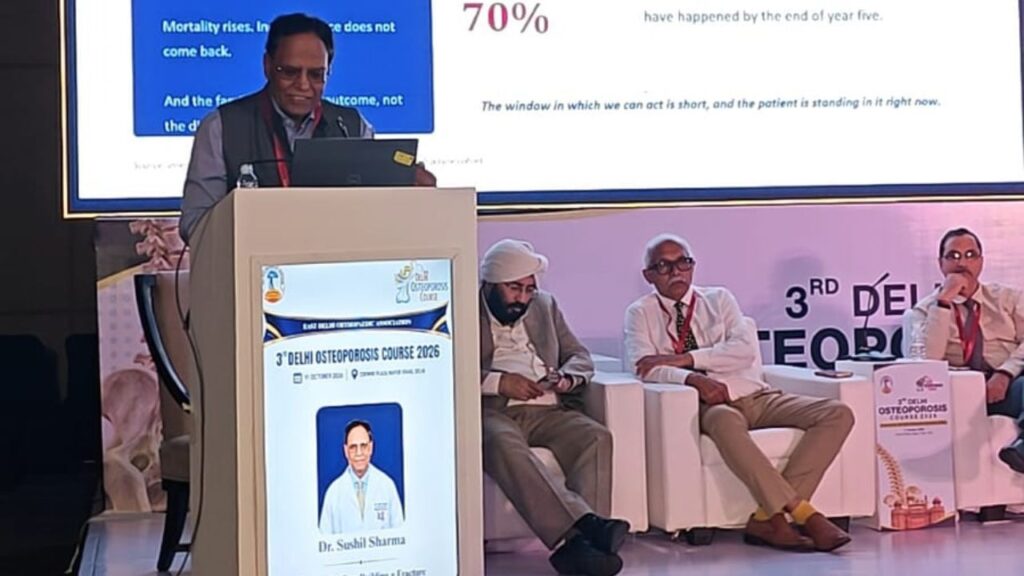
“The next fracture is already scheduled,” Dr Sharma told surgeons during his presentation on osteoporosis and the fragility fracture network at the 3rd Delhi Osteoporosis Course 2026, organised by the East Delhi Orthopaedic Association. “The window in which we can act is short, and the patient is standing in it right now.”
What is the real risk of a second fracture?
A hip that breaks after a minor fall, from standing height or less, is called a fragility fracture. It is usually the first visible sign of osteoporosis, a condition in which bones lose strength silently over many years.
The figures Dr Sharma presented, drawn from an International Osteoporosis Foundation (IOF) study across 19 countries, show how quickly the danger returns:
- Between 5% and 10% of hip fracture patients go on to break their other hip.
- Nearly a quarter (23%) of those second fractures happen within the first year.
- By the end of year five, 70% of them have already happened.
In other words, the risk is not spread evenly over a lifetime. It is concentrated in the months straight after the first break.
A second hip fracture means a second operation, on a patient who is now older and frailer. “Mortality rises. Independence does not come back,” Dr Sharma warned.
Why is India so far behind?
In much of the developed world, hospitals run a Fracture Liaison Service, or FLS. It is a simple system. A trained coordinator identifies every patient admitted with a fragility fracture, makes sure their bone health is assessed and treated, and follows them up for years.
The IOF’s Capture the Fracture programme now counts more than 1,300 such services in 64 countries.
India’s picture is starkly different. Citing the APCO-IOF Asia Pacific Regional Audit 2025, Dr Sharma said only about 1% of Indian hospitals have a Fracture Liaison Service. That is despite 293.9 million Indians already being aged 50 or over. The country has no national fracture database, and osteoporosis is not a national health priority.
“One percent,” he told the hall. “That is not a treatment gap. That is an absence.”
Does it actually work?
The evidence from places that have built these services is striking.
At Kaiser Permanente in Southern California, a programme led by orthopaedic surgeons cut hip fracture rates by an average of 37.2% among people at risk. Research cited in the lecture found the risk of a repeat fracture was 74% lower in the first year after treatment, and 32% lower in the years after.
In Scotland, Glasgow introduced a Fracture Liaison Service and saw hip fracture rates fall by around 7% over a decade, according to a review cited by Dr Sharma. Over the same period, rates in England rose by around 17%.
In the UK, the Royal Osteoporosis Society estimates that an extra £30m a year for these services across England would prevent 74,000 fractures over five years and save the NHS £665m.
“Same decade, same health system, same drugs,” Dr Sharma said. “The difference was a coordinator.”
How a Delhi service would work
Dr Sharma is proposing that Delhi become the first Indian city with a working Fracture Liaison Service, built and led by orthopaedic surgeons themselves.
The model is deliberately simple. It covers patients aged 60 and above with a hip or spine fragility fracture:
- The surgeon operates, as usual.
- The surgeon sends one message to the Delhi FLS group.
- A paid coordinator calls the patient and family.
- Bone-strengthening treatment is started by the treating surgeon.
- A bone density (DXA) scan is arranged when feasible.
- The coordinator keeps in touch through scheduled follow-up for two to five years.
Crucially, the patient is not passed on. “The patient stays yours. Full stop,” Dr Sharma told fellow surgeons. The coordinator reminds, chases and records, but does not treat or advise. The treating orthopaedic surgeon stays in charge from the first fracture to the fifth year.
His appeal to the room was direct: if 20 surgeons sign up, Delhi can start.
What families can do now
Until such services are widespread, much depends on patients and families asking the right questions. If someone you care for has broken a hip, wrist, shoulder or spine bone after a minor fall:
- Ask the surgeon whether the fracture could be caused by osteoporosis.
- Ask whether bone-strengthening treatment should begin before discharge or soon after.
- Ask about a bone density (DXA) scan and blood tests, including vitamin D.
- Ask about falls prevention, such as balance and walking support, and making the home safer.
- Keep follow-up appointments for the next few years, even when the patient feels well.
The broken bone is the warning. As Dr Sharma put it, the first fracture tells you the next one is coming, and the first year is when there is still time to stop it.
Frequently asked questions
What is the risk of a second hip fracture after the first one?
Between 5% and 10% of people who break a hip go on to break the other hip, according to International Osteoporosis Foundation data presented by orthopaedic surgeon Dr Sushil Sharma of Kailash Hospital, Noida. About 23% of these second fractures happen within the first year, and 70% within five years, which is why treatment should start soon after the first fracture.
What is a fragility fracture?
A fragility fracture is a broken bone caused by a fall from standing height or less, or by a force that would not normally break a healthy bone. Common sites are the hip, spine, wrist and shoulder. It is often the first sign of osteoporosis.
What is a Fracture Liaison Service (FLS)?
A Fracture Liaison Service is a hospital system in which a dedicated coordinator identifies patients with fragility fractures, arranges bone health assessment and treatment, and follows them up for two to five years to prevent another fracture. It follows the International Osteoporosis Foundation’s 13 Capture the Fracture best-practice standards.
Does India have Fracture Liaison Services?
Only about 1% of Indian hospitals have a Fracture Liaison Service, according to the APCO-IOF Asia Pacific Regional Audit 2025. Worldwide there are more than 1,300 services in 64 countries. Dr Sushil Sharma of Kailash Hospital, Noida, has proposed a surgeon-led Delhi Fracture Liaison Service to make Delhi the first Indian city with one.
Is there a Fracture Liaison Service in Delhi?
A Delhi Fracture Liaison Service initiative was proposed by orthopaedic surgeon Dr Sushil Sharma of Kailash Hospital, Noida, in his presentation on osteoporosis and the fragility fracture network at the 3rd Delhi Osteoporosis Course in October 2026. Under the model, orthopaedic surgeons notify each hip or spine fragility fracture in patients aged 60 and above, and a coordinator handles follow-up for two to five years.
Do Fracture Liaison Services actually reduce fractures?
Yes. Kaiser Permanente’s surgeon-led programme in Southern California cut hip fracture rates by an average of 37.2% among people at risk, and research shows refracture risk falls by about 74% in the first year. Glasgow, which runs an FLS, saw hip fracture rates fall by around 7% over a decade, while England’s rose by around 17%.
Should my orthopaedic surgeon treat osteoporosis after a fracture?
In the Delhi model proposed by Dr Sushil Sharma, the treating orthopaedic surgeon starts and manages bone-strengthening treatment, rather than referring the patient elsewhere. Patients should ask their surgeon before discharge whether their fracture is osteoporosis-related and what treatment is planned.
What should families ask after an elderly parent breaks a hip?
Ask whether the fracture is due to osteoporosis, whether bone treatment will begin soon, whether a DXA bone density scan and vitamin D test are needed, and what can be done to prevent falls. Keep follow-up appointments for at least two to five years.
Who is Dr Sushil Sharma?
Dr Sushil Sharma is a Senior Consultant in Orthopaedics and Joint Replacement at Kailash Hospital, Noida. He trained in joint replacement surgery at University Hospital Geneva, Switzerland, is a member of the International Osteoporosis Foundation, and is the author of “Defeat Osteoporosis”. At the 3rd Delhi Osteoporosis Course 2026 he presented on osteoporosis and the fragility fracture network and proposed the Delhi Fracture Liaison Service initiative.
About the expert
Dr Sushil Sharma is a Senior Consultant in Orthopaedics and Joint Replacement at Kailash Hospital, Noida. He completed a fellowship in joint replacement surgery at University Hospital Geneva, Switzerland. He received the Roche GSK Award in Istanbul (2005) and the Linda Edwards Memorial Award in Beijing (2009). He is a member of the Indian Orthopaedic Association, the Indian Arthroplasty Association and the International Osteoporosis Foundation, and the author of “Defeat Osteoporosis” and “Bones and Breaks, Total Orthopedic Solutions”. He leads the Delhi Fracture Liaison Service Initiative, which aims to make Delhi the first Indian city with a surgeon-led Fracture Liaison Service.
Sources
- APCO-IOF Asia Pacific Regional Audit 2025, International Osteoporosis Foundation
- Capture the Fracture Annual Report 2025, International Osteoporosis Foundation
- Healthy Bones Program reduces hip fractures by 37 percent, Kaiser Permanente study (Dell et al.)
- IOF supports ROS campaign for 100% Fracture Liaison Service coverage, Royal Osteoporosis Society figures
- International Osteoporosis Foundation, 2023, 19-country hip fracture cohort
- Glasgow Osteoporosis and Falls Strategy review
- Ebeling P., New England Journal of Medicine, 2025
Medical disclaimer
This article is for general awareness and is not a substitute for medical advice. Anyone who has had a fracture should discuss bone health, testing and treatment with their own doctor.